Text: 1 Samuel 4:1–22 (ESV)
Theme: God will not be manipulated by religion, and He will not share His glory.
Big Idea: Israel lost the battle because they wanted God's power without God Himself — and the Lord defended His own holiness even at the cost of His people's defeat.
Ps 78:60–64 He forsook his dwelling at Shiloh, the tent where he dwelt among mankind, 61 and delivered his power to captivity, his glory to the hand of the foe. 62 He gave his people over to the sword and vented his wrath on his heritage. 63 Fire devoured their young men, and their young women had no marriage song. 64 Their priests fell by the sword, and their widows made no lamentation.
Jeremiah 7:11-14 Has this house, which is called by my name, become a den of robbers in your eyes? Behold, I myself have seen it, declares the Lord. Go now to my place that was in Shiloh, where I made my name dwell at first, and see what I did to it because of the evil of my people Israel. And now, because you have done all these things, declares the Lord, and when I spoke to you persistently you did not listen, and when I called you, you did not answer, therefore I will do to the house that is called by my name, and in which you trust, and to the place that I gave to you and to your fathers, as I did to Shiloh.
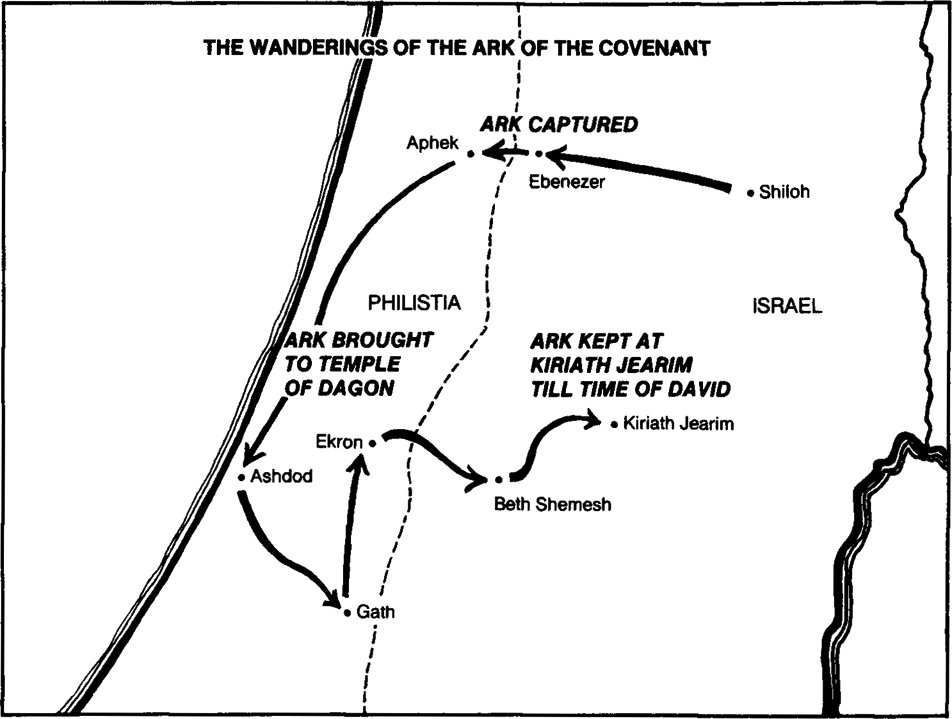
I. Setting the Scene
Historical setting
-
Late period of the judges, roughly the 11th century B.C. Israel is a loose tribal confederation with no king.
-
The Philistines are the dominant military power on the coastal plain, with iron technology and organized armies (cf. 1 Samuel 13:19–22).
-
Shiloh is the central sanctuary, housing the tabernacle and the ark of the covenant.
Literary setting — read chapters 2–3 first
-
1 Samuel 2:12–17, 22–25 — Hophni and Phinehas are described as worthless men who do not know the LORD; they steal from sacrifices and defile the tabernacle.
-
1 Samuel 2:27–36 — an unnamed man of God pronounces judgment on Eli's house; both sons will die on the same day.
-
1 Samuel 3:11–14 — Samuel receives the same word: the guilt of Eli's house will not be atoned for by sacrifice or offering.
Teaching note: Chapter 4 is not a surprise. It is the collection of a debt announced two chapters earlier. Everything in this chapter is prophecy being kept.
II. Outline of the Text
A. The First Defeat and the Wrong Diagnosis (4:1–4)
-
Israel encamps at Ebenezer, the Philistines at Aphek. Israel is defeated, losing about four thousand men (vv. 1–2).
-
The elders ask the right question — why has the LORD defeated us? — but then reach for the wrong solution (v. 3).
-
Rather than repentance, they send to Shiloh for the ark, expecting it to save them from their enemies.
-
Note the detail in verse 4: Hophni and Phinehas come along with the ark. The very men under sentence of death are escorting the throne of God into battle.
Key observation: They correctly recognize that the defeat came from the LORD. They incorrectly conclude that the remedy is a religious object rather than a changed heart.
B. The Second Defeat and the Captured Ark (4:5–11)
-
The ark arrives; Israel shouts so loudly the ground shakes (v. 5). Enthusiasm is high. Repentance is absent.
-
The Philistines are terrified, and their theology is revealing (vv. 6–8). They remember what the God of Israel did to Egypt — though they garble the details, speaking of gods in the plural and confusing the plagues with the wilderness.
-
Philistine leaders rally their troops with a call to act like men rather than become slaves (v. 9). Pagan resolve outmatches Israelite superstition.
-
The result (vv. 10–11): a catastrophic defeat — thirty thousand foot soldiers fall, the ark is captured, and Hophni and Phinehas die on the same day, exactly as prophesied.
Key observation: The loudest religious moment in the chapter is immediately followed by the greatest disaster in the chapter.
Deuteronomy 28:25-26 “The LORD will cause you to be defeated before your enemies. You shall go out one way against them and flee seven ways before them. And you shall be a horror to all the kingdoms of the earth. And your dead body shall be food for all birds of the air and for the beasts of the earth, and there shall be no one to frighten them away.
C. The Death of Eli (4:12–18)
-
A Benjaminite runner reaches Shiloh with torn clothes and dirt on his head, the standard signs of mourning (v. 12).
-
Eli, ninety-eight years old and blind, sits watching by the road — his heart trembling for the ark (v. 13).
-
The messenger delivers four escalating blows (v. 17): Israel fled, there was great slaughter, your two sons are dead, and the ark has been captured.
-
Eli falls backward, breaks his neck, and dies — the narrator notes he was old and heavy. He had judged Israel forty years (v. 18).
Key observation: The text says Eli fell when the ark was mentioned, not when his sons were mentioned. His last recorded concern is genuinely for God's honor — which makes his lifelong failure to restrain his sons all the more tragic.
D. Ichabod: The Glory Departed (4:19–22)
-
The wife of Phinehas, near the end of her pregnancy, goes into labor at the news (v. 19).
-
The midwives try to comfort her with the birth of a son; she does not answer or pay attention (v. 20).
-
She names the child Ichabod — "no glory" or "where is the glory?" — declaring that the glory has departed from Israel (vv. 21–22).
-
She names three losses, but repeats only one twice: the ark of God has been captured. Her grief is theological before it is personal.
Key observation: The chapter ends not with a military assessment but with a worship assessment. The tragedy is not primarily that Israel lost a battle. It is that God's manifest presence has withdrawn.
III. Commentary Perspectives
Note on sources: These summarize the characteristic emphases of each teacher on this passage and the themes in it. Verify exact wording and page references before quoting any of them directly in a lesson. The 1 Samuel section of The Bible Knowledge Commentary (Walvoord and Zuck, general editors) was written by Eugene Merrill.
John MacArthur — Ritual Without Repentance
-
MacArthur consistently reads this chapter as a case study in treating a God-given symbol as a good-luck charm. The ark was the place where God met His people in mercy; Israel reduced it to a talisman for the battlefield.
-
He stresses the fulfillment theme: the death of Hophni and Phinehas on the same day is the exact discharge of the word given in 2:34. God's warnings are not rhetorical.
-
He draws attention to the moral condition of the priesthood. Sacred office does not protect a corrupt heart, and the presence of ordained men at the head of the procession did nothing to secure God's blessing.
-
Application he characteristically draws: outward religion — attendance, symbols, ceremonies, even orthodox objects — cannot substitute for a heart submitted to God's revealed Word.
John Walvoord (and the Bible Knowledge Commentary tradition) — Covenant Discipline and God's Purposes for Israel
-
The defeat is read as covenant discipline, precisely the kind of military reversal Moses warned about in Deuteronomy 28:25 for a nation in disobedience. God is honoring His covenant terms, not failing them.
-
The BKC treatment highlights that Israel's error was theological confusion between God's presence and the object that symbolized it. The ark represented the throne of the invisible King; it never contained Him.
-
Attention is given to the historical outworking: Shiloh as a sanctuary effectively ends here. Later Scripture treats this as a landmark judgment — Psalm 78:60–64 and Jeremiah 7:12–14 both point back to what God did to Shiloh as a warning.
-
Consistent with Walvoord's broader framework, the loss is disciplinary and not final. God's covenant purposes for Israel continue; the ark is not defeated but goes on to humiliate Dagon in chapter 5, and the narrative moves toward Samuel, then David.
John Piper — God's Jealousy for His Own Glory
-
Piper's governing theme fits this chapter directly: God's ultimate commitment is to the display of His own glory, and He will not permit that glory to be used as a means to any lesser end.
-
Israel's sin was wanting God's power without wanting God. They sought the benefit of His presence while remaining indifferent to His person and His holiness. Piper would frame this as treating God as a means rather than a treasure.
-
The apparent paradox: God gains more glory by letting His ark be captured than by rescuing a people who presume on Him. He would rather look defeated for a season than look manageable.
-
The Ichabod moment is, in this framing, an act of mercy as much as judgment — the withdrawal of glory is what exposes to Israel that the glory was the point all along.
IV. Theological Threads to Draw Out
-
God's presence is a person, not a possession. The ark was real, God-ordained, and holy — and it was still not God. Sacred things become idols the moment we trust them instead of Him.
-
God's word always lands. Every specific detail of the judgment announced in chapter 2 comes to pass in chapter 4.
-
God is not partisan; He is holy. He allowed His own name to be associated with defeat rather than bless a people living in unrepentant sin.
-
Judgment on leadership is severe. Eli's passive tolerance of his sons' sin brought down an entire priestly house (cf. James 3:1).
-
The story is not over. Chapter 5 shows the ark toppling Dagon in his own temple. God needed no army to defend Himself.
Christ connection: Israel's ark was captured; Christ's body was crucified. In both cases God's apparent defeat was the stage for His clearest victory. Where Ichabod means the glory departed, John 1:14 declares that the Word became flesh and we have seen His glory. What was lost at Shiloh returns permanently in Christ, and by the Spirit that glory now dwells in the church (2 Corinthians 3:18; 1 Corinthians 3:16).
V. Practical Applications for Christians Today
1. Audit your talismans.
Israel had a real, God-given object and still misused it. Ask honestly: what do I treat as a guarantee of God's favor? A daily reading streak, a church membership, a worship playlist, a study Bible, a ministry role, a particular translation, a devotional habit. All good. None of them saves. The question is whether the practice is drawing me to Christ or standing in for Him.
2. Answer the "why" honestly when things go wrong.
The elders asked the right question in verse 3 and then refused to sit with the answer. When we face reversal, the instinct is to reach for a technique — a new program, a new method, a new intensity. Sometimes the faithful response is to stop, examine, confess, and wait rather than to escalate activity.
3. Volume is not the same as faith.
The shout in verse 5 shook the ground and changed nothing. Emotional intensity in worship is not the measure of God's pleasure. Test enthusiasm by obedience, not by feeling.
4. Deal with sin you have authority over.
Eli knew, spoke mildly, and did nothing further. Passive tolerance of sin in a home, a small group, or a church staff is not gentleness. Confront early, restore humbly, and take seriously the weight of any position of spiritual influence you hold (Galatians 6:1; Hebrews 13:17).
5. Don't use God as a means to an end.
Ask what you actually want when you pray: the outcome, or the God who gives it? A prayer life aimed only at results will feel abandoned the moment results stop coming. A prayer life aimed at God survives defeat.
6. Grieve the right losses.
Phinehas's wife had lost husband, father-in-law, and nation — and named her son for the loss of God's presence. Modern churches often measure decline by budget, attendance, and influence. The more searching question is whether the glory is still evident among us.
7. Trust God's vindication on His timetable.
Chapter 4 ends in disaster. Chapter 5 begins the reversal, and God does it without a single Israelite soldier. When God's cause looks defeated in your workplace, family, or culture, remember that He is fully capable of defending His own name — and often does it in ways no one would have planned.
VI. Discussion Questions
-
The elders asked why the LORD had defeated them (v. 3) but never waited for an answer. Why is it easier to reach for a solution than to sit with a diagnosis?
-
The Philistines had a more accurate fear of God's power than Israel did (vv. 7–8). What does it say when outsiders take God more seriously than His own people?
-
Eli's heart trembled for the ark (v. 13), yet he never restrained his sons. How can genuine reverence coexist with practical disobedience?
-
What would it look like for a church today to say "the glory has departed"? What are the honest indicators?
-
Where in your life are you seeking God's help more than God Himself?
-
Read 1 Samuel 5:1–5. How does God's action there reframe the ending of chapter 4?
VII. Suggested Cross-References
| Theme | Passages |
|---|---|
| Prophecy fulfilled | 1 Samuel 2:27–36; 3:11–14 |
| Covenant discipline | Deuteronomy 28:25; Leviticus 26:17 |
| Shiloh's judgment remembered | Psalm 78:56–64; Jeremiah 7:12–14; 26:6 |
| God's jealousy for His glory | Isaiah 42:8; 48:11; Ezekiel 36:22–23 |
| Empty religion | Isaiah 1:11–17; Matthew 15:8–9; 2 Timothy 3:5 |
| Glory restored in Christ | John 1:14; 2 Corinthians 3:18; 4:6 |
| Leadership accountability | James 3:1; 1 Timothy 3:4–5 |
VIII. One-Sentence Takeaway
Israel carried the ark into battle to make God serve their agenda; God let the ark be captured to remind them He has an agenda of His own — and it is the glory of His name.